Thursday, September 28, 2017

Sept 26 to 28 - Backyard and Chilliwack

This is the second to last post for September 2017. Here's a couple of photos taken from the back porch at home. We get some Golden Crowned Sparrows in the yard, this one looks like an adult in winter plumage.


Golden-crowned Sparrow - Backyard, North Delta BC

A sign that winter is coming is the reappearance of Juncos. We'll have them in good numbers for the next 6 months as long as we keep the feeders filled.


Dark-eyed Junco - Backyard, North Delta BC

We'll have a few finches hang around for the winter, this female house finch might be one of them.

House Finch (F) - Backyard, North Delta BC


September 28th - Chilliwack

I had the day off from work and was playing golf in the afternoon in Langley. I decided to travel out to Chilliwack in the morning. There'd been a report of Cackling Geese arriving at Sardis Park, where they'll likely stay for the winter.

My first stop was the Great Blue Heron Reserve in Greendale, a community to the west of Sardis.


I've visited here frequently but really only had one good outing. Today it was scarce again but I did get a photo of a common sparrow. The dark head indicates a juvenile bird.

White-crowned Sparrow (Imm) - Great Blue Heron Reserve, Chilliwack BC

My next stop was Sardis Park where I hoped to see the Cackling Geese. They are similar to Canada Geese, but are much smaller. They have a distinctive call which you can here in the video below.

When the Geese arrive at the park they do so in large numbers. This is a mix of Canada Geese (Large) and Cackling Geese (small). They were all classified as Canada Geese before 2004 when Cackling Goose was split into a separate species 

Cackling Geese - Sardis Park, Chilliwack BC

Here's a close up of one, you can see the size difference and the shorter beak. I'd seen one of them in April in the Okanagan but this is the first good photo.

Cackling Goose - Sardis Park, Chilliwack BC

The noise that all the geese made was very loud as you can hear in the video below:


I took this photo of the bird below, I'm not sure if this is a goose or a duck. The all white condition is called leucism meaning the bird cant' produce coloured pigment for its feathers. It is not an Albino bird.


It was time to leave for my golf game in east Langley. Little did I know that there had been a massive accident on Highway 1 and I'd be sitting in traffic for an extra 45 minutes. I just made in time and did see one bird on the golf course.

Pied-billed Grebe - Pagoda Ridge Golf Course, Langley BC

The Geese made the day worthwhile in spite of the traffic problems. The golf was fun too.

Sunday, September 24, 2017

Rare Birds at Iona and Point Roberts

The rare bird alert reported that a Sharp-tailed Sandpiper had been seen the day before in the settling ponds at Iona Regional Park in Richmond. I'd had this bird on my target list for a few years but had never had the luck to see one. Could I get two lifers in one week?

The big problem with seeing a Sharp-tailed is that it is very similar to the common Pectoral Sandpiper and the strays tend to associate with the Pectorals.

I arrived quite early and started checking out the birds on my way in and saw a group of pectorals almost immediately. I took some shots for reference. This one turned out quite well and shows a Pectoral on the left and a smaller Western Sandpiper on the right.


Pectoral and Western Sandpiper - Iona Regional Park, Richmond BC

I made my way around to the Northeast Settling pond where the Sharp-tailed had been seen the day before. There were quite a few birders around, most of them like me looking to see the bird for the first time.

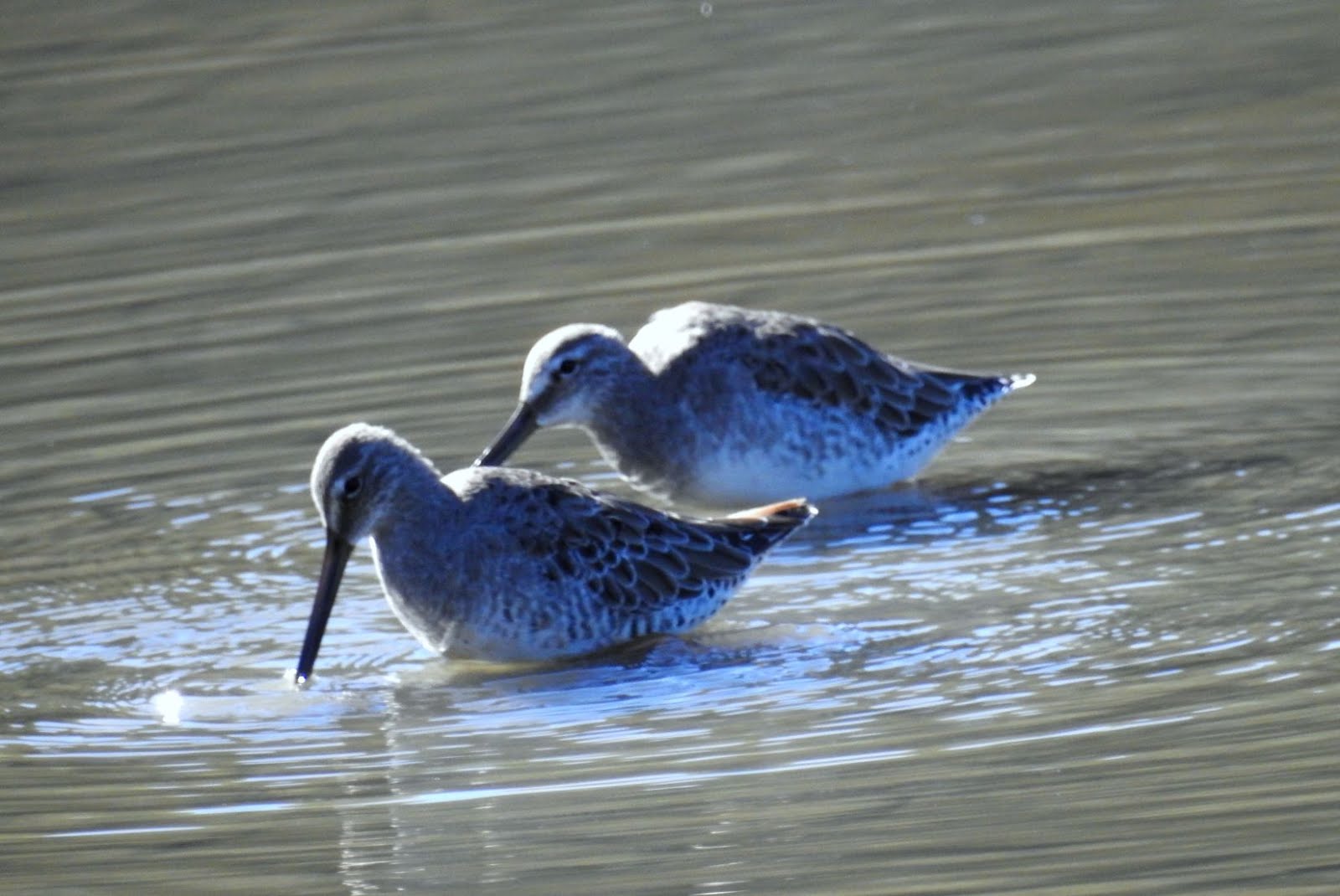
A group of birds landed in the muck behind us, they were all Long-billed Dowitchers.


Long-billed Dowitcher - Iona Regional Park, Richmond BC

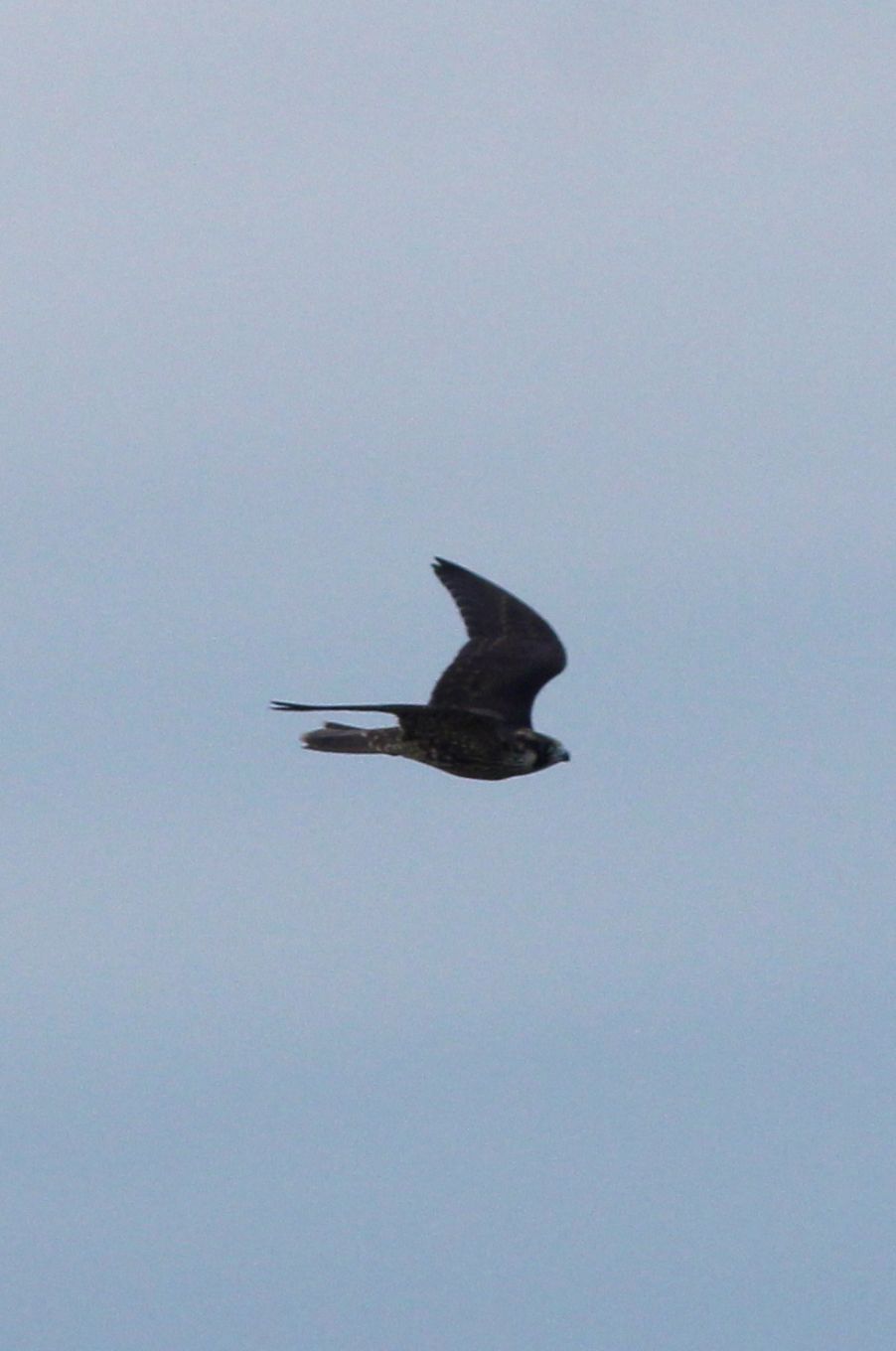
As we were scanning the flocks the resident Peregrine Falcon flew over and scattered all the shorebirds and ducks. We'd have to start over.

Peregrine Falcon - Iona Regional Park, Richmond BC

As it turned out, the Peregrine did us a favour. Most of the shorebirds moved to the Southeast pond along the shoreline. One lady thought she saw something a bit different and we were able to locate the bird in our scopes.

We confirmed it had to be the Sharp-tailed as it had a buffy breast and a reddish crest compared to the brownish crest of the Pectoral. However, the bird was partially obscured and I was only able to get one open shot with the Nikon zoomed out to maximum. But it enough to convince me I had my second lifer in a week. Hopefully, I can get a better shot of one sometime in the future.

Sharp-tailed Sandpiper - Iona Regional Park, Richmond BC
Life List #422 - 2017 Bird #198

After seeing this bird, I decided I had time to go to Point Roberts where a Lapland Longspur had been seen. 

On my way out of Iona, I took photos of a couple of resident sparrows. The first is in Basic (winter) plumage.

White-crowned Sparrow - Iona Regional Park, Richmond BC


Song Sparrow - Iona Regional Park, Richmond BC


Point Roberts

It's becoming routine to make a short visit here each Sunday for gas and birding. This time I had a target bird to look for. A Lapland Longspur had been seen recently by none other than Chris Charlesworth. I assume he was leading a of Lower Mainland Fall tour.

It was a nice sunny day and I tried for an artistic photo of the Cormorant pilings.


The Longspur had been seen at the very south-eastern boundary of the park. As I was walking that way I noticed a Northern Harrier in the distance. I can't recall seeing one here before. Interestingly, it flew out over the ocean, something else I'd never witnessed.


Northern Harrier - Lighthouse Marine Park, Point Roberts WA

I found my way to the edge of the park but could not locate the Longspur. As I headed back, I noticed a small bird in amongst the driftwood on the shore. It was my Longspur!

I had seen one at Iona back in April, but only had a fleeting glimpse. This bird was much more cooperative and I took numerous photos. The one below was the best.


Lapland Longspur - Lighthouse Marine Park, Point Roberts WA

It had been a busy morning, I made my way back to the car and headed for home.

Sunday, September 17, 2017

A Great Day at Point Roberts

Another trip for gas and birding. The weather conditions were reasonably good, but the active surf could make it hard to take good photos of birds on the water.


I did get some shots of Pigeon Guillemots near the shore. They look completely different in their Basic plumage. My blog post from North Vancouver in June shows them in Alternate (Breeding) plumage.


Pigeon Guillemot - Lighthouse Marine Park, Point Roberts WA

I saw a couple of people I knew from the Delta Naturalists group who were down on the shoreline. The were looking offshore at a group of Gulls in flight. I then saw that a larger bird was harassing the Gulls and immediately realized it was a Jaeger. These oceanic birds are seldom seen this close to shore, but there had been some sightings here in the past.

I took some shots and confirmed with the others that it was a Parasitic Jaeger, my first lifer in almost a year!


Parasitic Jaeger - Lighthouse Marine Park, Point Roberts WA
Lifer # 421 and 2017 Bird #197

The reason they watch and then chase the Gulls is to steal fish that they catch. They are bigger and faster than the Gulls, and this is quite often the end result.

Parasitic Jaeger  - Lighthouse Marine Park, Point Roberts WA

This shot is the best one and shows the unusual tail shape that this bird has. This is my second Jaeger species, I saw a Pomarine Jaeger in 2015 on a pelagic trip off Ucluelet.

Parasitic Jaeger  - Lighthouse Marine Park, Point Roberts WA

After that excitement it was back to the Guillemots, I suspect the two in the foreground are first year birds.

Pigeon Guillemot - Lighthouse Marine Park, Point Roberts WA

Further offshore were a pair of Red-necked Grebes. I isolated on the the closer one with the Nikon.

Red-necked Grebe - Lighthouse Marine Park, Point Roberts WA

A large Tern flew overhead and I only had time for one shot, the large red bill identifies it as a Caspian Tern.

Caspian Tern - Lighthouse Marine Park, Point Roberts WA

My last photo is a close-up of a Bonaparte's Gull. Earlier there had been a large flock of them far offshore. They might have been the catalyst for the Jaeger to come looking for food. 

When in Alternate plumage this gull features a black head. In winter it reverts to the more subtle Basic plumage.

Bonaparte's Gull - Lighthouse Marine Park, Point Roberts WA

It was time to gas up and head for home to brag about my new life bird.


Monday, September 11, 2017

Vacation Day at Reifel

I had a golf outing later in the day, so I decided to go birding at Reifel in the morning. There had been a very rare bird seen (a Curlew Sandpiper) on the weekend which I hoped to see. No luck with that one, but my first bird of the day was a good consolation prize.

The Stilt Sandpiper is uncommon here, but it seems one or two show up in Fall migration each year. As I headed out along the west dyke trail, I came across some birders who were looking at one. It's the bird in the back with the head turned backwards.


Stilt Sandpiper - Reifel Bird Sanctuary, Delta BC - 2017 Bird #196

At this time of year there are many Yellowlegs at Reifel. Most of them are Greater Yellowlegs, but there's usually a few Lesser as well. I believe these are all Greater.


Greater Yellowlegs - Reifel Bird Sanctuary, Delta BC

It's not unusual to see Sandhill Cranes at Reifel, but it's a treat to see them flying overhead.


Sandhill Crane - Reifel Bird Sanctuary, Delta BC

Finally, there were some Long-billed Dowitchers fairly close in the House Pond.


Long-billed Dowitcher - Reifel Bird Sanctuary, Delta BC

It was time to head to Pitt Meadows for golf.

Sunday, September 10, 2017

Another Sunday morning at Point Roberts

With the price of gas in Metro Vancouver, I've been motivated to visit Point Roberts every weekend. Once there, I always visit Lighthouse Marine Park. This Sunday was pretty quiet, but there was a an interesting bit of action to make the visit worthwhile.

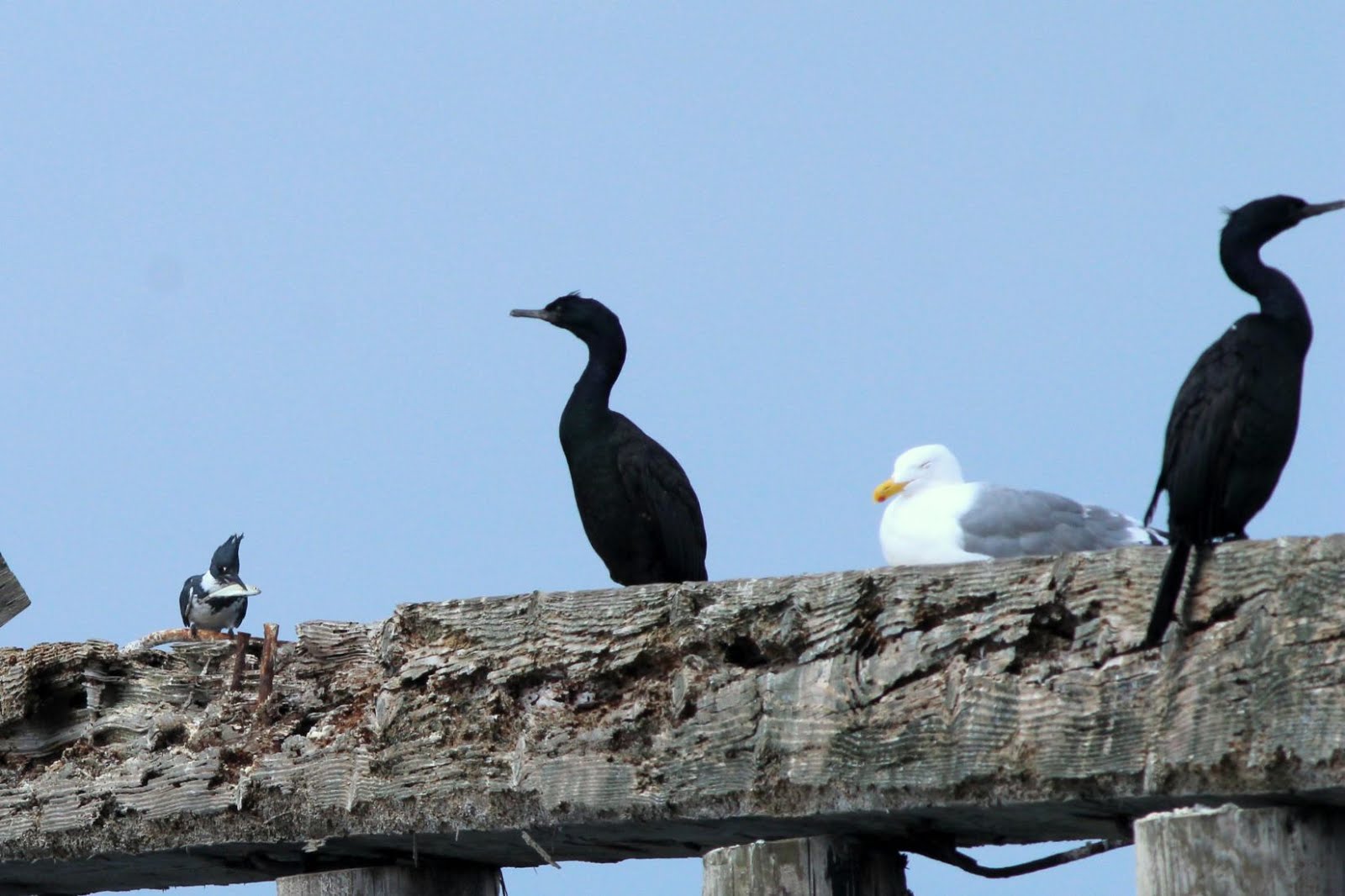
To the northwest of the parking area there are a number of pilings where Cormorants and Gulls congregate. It's also a reliable location for Belted Kingfisher, I've seen both a male and a female there.

I usually check this area first before heading south east. It was a dreary grey morning, not the best for photography.

Here's a shot of a Pelagic Cormorant, identified by the head shape and the long thin beak.


Pelagic Cormorant - Lighthouse Marine Park, Point Roberts WA

The male Kingfisher was present today, he is identified by the absence of any reddish brown colour on the breast.


Belted Kingfisher - Lighthouse Marine Park, Point Roberts WA

Another common bird is the Ring-billed Gull. This photo captures it quite well. The distinguishing field marks are the black ring on the bill, the pale eye and the yellow legs. It's also smaller than most other Gulls.

Ring-billed Gull - Lighthouse Marine Park, Point Roberts WA

After taking off and diving into the surf, the Kingfisher returned with a catch. The trick now was to keep it away from the other birds on the pier.


Belted Kingfisher - Lighthouse Marine Park, Point Roberts WA

They seemed oblivious at first, but shortly after this next photo, the Kingfisher flew off to find a more private area.


Belted Kingfisher - Lighthouse Marine Park, Point Roberts WA

There wasn't much going on elsewhere in the park on this day, so I headed for home.

Saturday, September 2, 2017

Fall Evenings at Boundary Bay

September is prime time for shorebirds at Boundary Bay. There had been many reports of Bar-tailed Godwits and other shorebirds on the dike at 96 St in late August. This was my first opportunity to get out and see for myself.

I parked at 104 St and made the two Km walk west along the dike with all my gear.

There were plenty of shorebirds but the "high" tide still left them over 100 meters away. The first bird I located was a Bar-tailed Godwit. Even in the scope it was difficult to see. It was facing away with its head tucked in most of the time. I did take a couple of digiscope photos with the IPhone which mostly proved that I did see a Godwit (Facing away at the rear).

Bar-tailed Godwit - Boundary Bay 96 St, Delta BC - 2017 Bird #193

This shot shows the Godwit in more detail. It's at the back with the long beak. The ID is based on what the expert birders say, there's not enough detail in these photos to really ID the bird.

Bar-tailed Godwit - Boundary Bay 96 St, Delta BC

There was a large gathering of local birders on site and it was fun to work with them to find the birds and ID them. Another bird that we saw was a Red Knot, a mid-sized shorebird that is common in Eastern North America. I had good scope views of it but did not take any photos. Here's a photo from September 3 2016, almost exactly a year before.

Red Knot - Boundary Bay 96 St, Delta BC - 2017 Bird # 194 (Photo taken in 2016)

We also saw Black and Ruddy Turnstones, the latter another eastern bird (see Jan 2017 post on this blog). Once again, no photos.

Another new bird for the year was a Short-billed Dowitcher. It takes a birding expert to positively ID a Short-billed vs a Long-billed of this species. We had an expert available and he identified it by the pattern on the tertial feathers. The Short-billed is also seen more commonly in salt water, the Long-billed prefers fresh water. These photos were actually taken on September 4th in pretty much the same location. The Dowitcher is to the left of the ducks.

Short-billed Dowitcher - Boundary Bay 96 St, Delta BC - 2017 Bird #195

Short-billed Dowitcher - Boundary Bay 96 St, Delta BC

On my drive back home, I spotted a falcon on a tree along 104 St. I took this shot out the car window.

Peregrine Falcon - 104 St, Delta BC

Thursday, August 31, 2017

August Birding

August can be a good month for birding, especially with shorebird migration heating up. I did not have a lot of success on my outings, so the posts are few. The big event of the month was our trip to see the solar eclipse in Oregon on August 21.

That trip is detailed in this blog: Vacation Birding and Eclipse Blog

August 6  - Reifel Bird Sanctuary

There were reports of Phalaropes at Reifel, so I headed there on this Sunday morning.

I made my way along the Southwest Marsh trail and took some more photos of the resident Great Blue Heron.

Great Blue Heron - Reifel Bird Sanctuary, Delta BC

This neck up shot is kind of creepy.
Great Blue Heron - Reifel Bird Sanctuary, Delta BC

I finally had a positive sighting of a Lesser Yellowlegs. The shape of the bird, the shorter downturned bill and the overall look of the bird distinguish it from its Greater cousin.

Lesser Yellowlegs - Reifel Bird Sanctuary, Delta BC - 2017 Bird #187

Off in the distance some birders were studying two pale looking shorebirds. They were definitely Phalaropes, but were they Wilson's or Red Necked? I see Wilson's when they are in breeding (Alternate) plumage, but was not quite sure about these winter (Basic) plumage birds. The dark around the eyes is seen in Wilson's in Breeding plumage, but they don't have it in Basic. 

However, red-necked in Basic plumage do have the black eyebrows. After seeing the photos at home, I concluded these were Red-necked.

Red-necked Phalarope - Reifel Bird Sanctuary, Delta BC - 2017 Bird #188

This shot was the best of the ones I took.

Red-necked Phalarope - Reifel Bird Sanctuary, Delta BC

A more common shorebird at Reifel is the Long-billed Dowitcher. They were here in good numbers on this Sunday.

Long-billed Dowitcher - Reifel Bird Sanctuary, Delta BC

I took this photo a couple of weeks later at Reifel, it was the only noteworthy photo on that outing.


This spider had the entrance to a blind completely blocked.

August 8th - Boundary Bay

The tides were favourable on this Tuesday evening, so I made a post-supper visit to Boundary Bay at 104 St. I did see some small shorebirds on this outing, but photographic conditions were tough. 

The most common shorebird at this time of year is the Black-bellied Plover. they are in their Basic plumage by this time, so they are somewhat bland looking. This photo was taken at a long distance, but it's the only one I have of this species so far this year.

Black-bellied Plover - Boundary Bay, 104 St. Delta BC

There was a period of time when there were numerous peeps close to shore. This photo has two common peeps (small shorebirds), a Semipalmated and a Western Sandpiper.

The Semipalmated can be difficult to tell from the Western, but the shorter stubbier bill on the bird on the left is a good diagnostic. That bird is also greyer than the one on the right.

Semipalmated Sandpiper (Left) and Western Sandpiper - Boundary Bay, 104 St. Delta BC

Here's a closer look at the Semi:
Semipalmated Sandpiper - Boundary Bay, 104 St. Delta BC - 2017 Bird # 190

For a brief period, I had two slightly larger sandpipers in front of me. The long wing projection is a good identifier for this species.

Baird's Sandpiper - Boundary Bay, 104 St. Delta BC

The last bird I saw was a Dunlin, a much larger bird with a very long bill.

Dunlin - Boundary Bay, 104 St. Delta BC


August 14th - Boundary Bay

I did a whole lot of walking to get the three photos below.  Actually this Eagle was right by the parking lot at the Airpark at 104 St. The walking happened after the photo.

Bald Eagle - Boundary Bay, 104 St. Delta BC

For a while I had this identified as a Semipalmated Plover, but I've changed my mind to Killdeer. That was my impression at the time, and the other photos I have look more like a Killdeer.

Killdeer - Boundary Bay, 96 St. Delta BC

The last bird is a Pectoral Sandpiper, normally quite common along Boundary Bay.  This is the only one I've seen this year.

Pectoral Sandpiper - Boundary Bay, 96 St. Delta BC

That was it for August, there'd be some more shorebirds in September.